- Acronyms
-
Ακρωνύμιο Περιγραφή ΑΕΙ Higher Education Institutions ΑΠΘ Aristotle University of Thessaloniki ΑΔΙΠ Quality Assurance and Certification Authority in Higher Education ΑΔΥ Vice-Rector for Administrative Affairs Α.&Ε. Μον. Academic & Research Units ΓΔ Directorate-General(s) ΓΠΑ Internship Office ΕΘΑΑΕ National Authority for Higher Education ΕΕΑΠ External Evaluation and Certification Committee ΕΛΚΕ Special Account for Research Funds ΕΣΔΠ Internal Quality Assurance System ΜΟΔΙΠ Quality Assurance Unit ΝΥ Legal Service ΟΜΕΑ Internal Evaluation Team ΣΕΕ Business Intelligence Systems ΠΜΣ Postgraduate Studies Program ΠΠΣ Undergraduate Studies Program ΠΣ Rector's Council ΠΦΛ University Student Club ΣΔΠ Quality Assurance System ΤΕΕΠ Department of European Educational Programmes Μ. Member(s) Στ. Executive(s) - A. Brief Description
-
The Internal Quality Assurance System (QAA) of the Aristotle University of Thessaloniki has been certified by the Authority for Quality Assurance and Certification in Higher Education (HQAA) in accordance with Decision 11710/16.09.2019 HQAA. The decision was valid from 10.09.2019 to 09.09.2023 and certified the full compliance of the AUTH EDP with the principles of the HQAA Quality Standard and the Quality Assurance Principles of the European Higher Education Area (ESG).
The visit of the External Evaluation and Accreditation Committee (ERC) of the Internal Quality Assurance System (EHRS) of the Aristotle University of Thessaloniki in relation to its compliance with the principles of the Quality Standard of the HQA (now HQAAE) and the Quality Assurance Principles (ESG) of the European Higher Education Area, took place in July 2019 and the Accreditation Report was prepared on 24 August 2019. ESDP-AUTh received the highest rating "Fully Compliant" overall, having received the rating "Substantially Compliant" in the Quality Principles:3. Establishing Goals for Quality Assurance,
6. Collection of Quality Data: measuring, Analysis and Improvement”, και
8. External Evaluation and Accreditation of the IQAS.The recommendations of the EEAP on all Quality Principles, regardless of the individual evaluations, were judged as particularly constructive for the University, although the majority of them transferred the know-how and experience of the EEAP from the Universities of origin of its members, not taking into account the weaknesses of the Higher Education system in Greece and in particular the restrictive and constantly changing institutional framework, underfunding and understaffing.
With a revised decision of the EAIA (31274/23.12.2022 EAEA), the duration of the certification was set at 5 years, i.e. until 09 September 2024.
- B. Action Plan
-
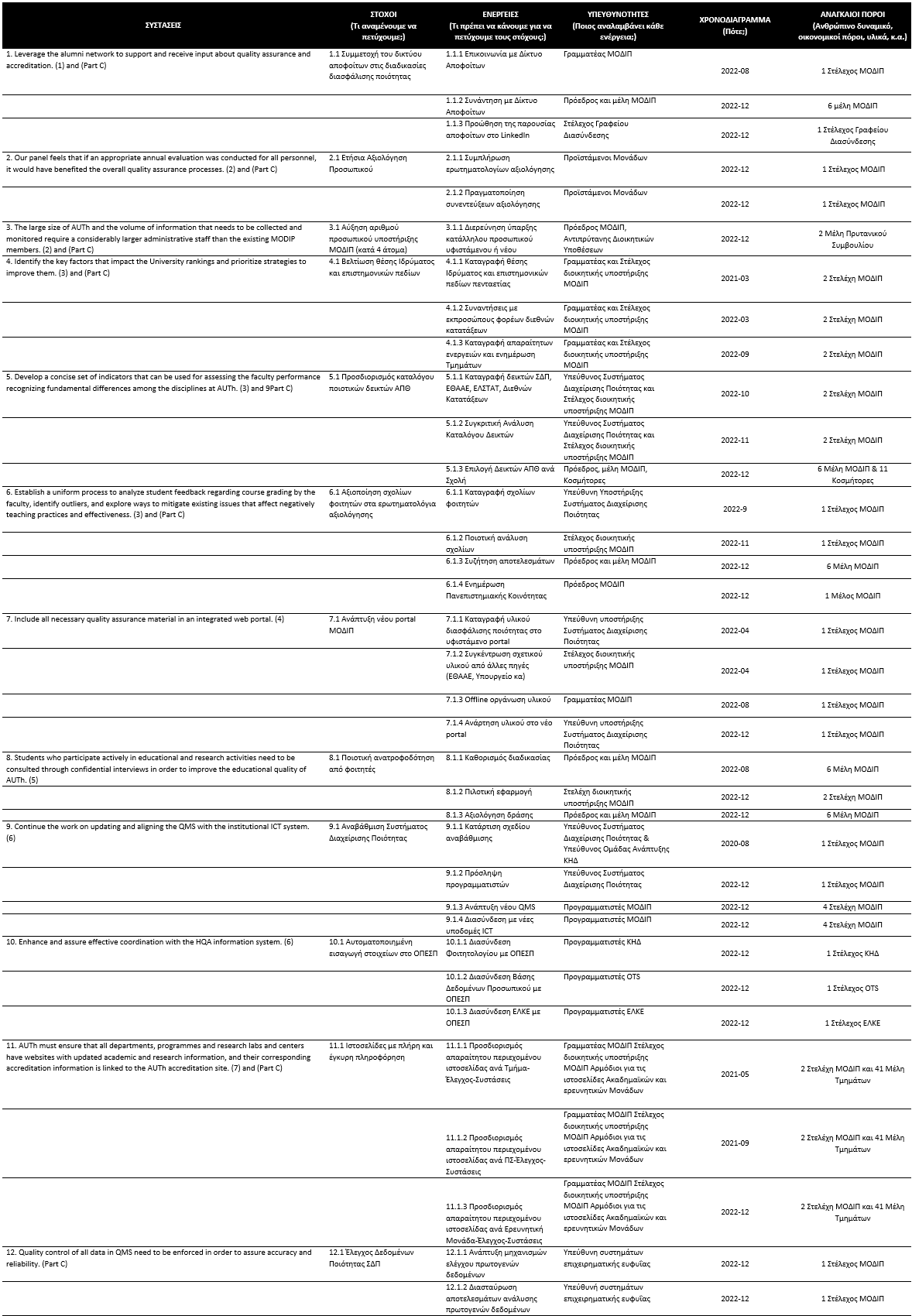
- C. Monitoring Report 04/2022
-
According to the instructions of the HAEAE, each Institution is obliged to submit to the HAEAE the "Monitoring Report" of the EDP (EDP) two years after the certification decision. On 06 April 2022, the Committee of the Aristotle University of Thessaloniki, following the relevant standard models of the HAEAE, as well as its clarifying instructions, drafted and sent the Monitoring Report to the HAEAE on 06 April 2022.
The Committee of MODIP/Aristotle University of Thessaloniki, in order to fully meet the requirements for the drafting and submission of the Monitoring Report, carried out the following actions.
Actions for the drafting of an Action Plan
- Study of the recommendations of the EEAP.
- Informing the various bodies of the Foundation's recommendations and the Foundation's obligation to respond to them.
- Cooperation of the MODIP Committee with competent bodies of the Foundation for advice and guidelines in relation to the recommendations of the EEOC.
- Cooperation of the MODIP Committee with the Foundation's bodies for the planning of the actions under their competence and the definition of recommendations that do not fall within the competence of the Foundation.
- Preparation of the Action Plan.
- Cooperation with external bodies within the framework of the NSRF for additional specialized knowledge and experience.
It is noted that at the time of the preparation of the Action Plan, the consequences of the pandemic were in progress, which decisively affected the operation and planning of the Aristotle University of Thessaloniki. As a result of this unprecedented crisis, the Foundation's short- and medium-term priorities were redefined, as the necessity of addressing most of the problems arising from the pandemic and the proper functioning of the Foundation in these circumstances became of primary importance.
With the above-mentioned data (mainly the special operating conditions due to the pandemic), a two-year Action Plan was considered appropriate and prepared, including only those recommendations that were exclusively related to the competence of the Aristotle University of Thessaloniki and that it was considered at the given period that it would be feasible to implement, regardless of any changes in the external environment.Actions for the preparation of a Monitoring Report
- Monitoring of the planned actions and the results achieved for the period 2019-2021.
- Preparation of the final Monitoring Report (Dated 06.04.2022).
C1. Recommendations of the Evaluation Committee that do not fall within the competence of the Foundation
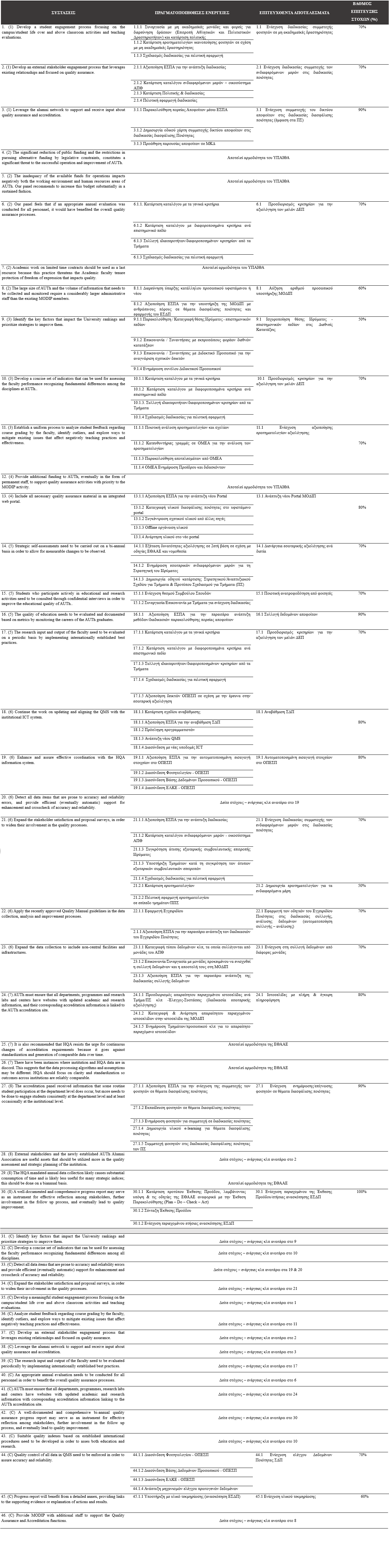
The evaluation report also includes recommendations, which do not fall within the competence of the Foundation. These recommendations are presented in the following table (Table A). It is noted that the Foundation makes efforts and proceeds to specific actions in order to achieve the greatest possible compliance.
Table A – Recommendations that do not fall within the competence of the Foundation
- 4. (2) The significant reduction of public funding and the restrictions in pursuing alternative funding by legislative constraints, constitutes a significant threat to the successful operation and improvement of AUTh.
The Foundation seeks and obtains funding (or support for it) from different sources such as European funded programs and projects, revenues from study programs (A and B cycle), funded short-term KEDIVIM programs, etc. - 5. (2) The inadequacy of the available funds for operations impacts negatively both the working environment and human resources areas of AUTh. Our panel recommends to increase this budget substantially in a sustained fashion.
See recommendation 1 above. In addition, the Foundation harmonizes with the requirements of Law 4957/2022 regarding the operation of the units and finds help from external partners until the final coverage of personnel needs is launched. - 7. (2) Academic work on limited time contracts should be used as a last resource because this practice threatens the Academic faculty tenure protection of freedom of expression that impacts quality.
The Aristotle University of Thessaloniki records the requirements and is in constant communication with the competent authorities requesting the filling of the positions with permanent staff in accordance with the procedures provided for and the applicable legislation. - 12. (4) Provide additional funding to AUTh, eventually in the form of permanent staff, to support quality assurance activities with priority to the MODIP activity.
The Aristotle University of Thessaloniki addresses the competent authorities in order to strengthen the permanent staff, in accordance with the procedures provided for and the applicable legislation. In addition, through NSRF programs, it ensures the strengthening of human resources. - 25. (7) It is also recommended that HQA resists the urge for continuous changes of accreditation requirements because it goes against standardization and generation of comparable data over time.
- 26. (7) There have been instances where institution and HQA data are in discord. This suggests that the data processing algorithms and assumptions may be different. HQA should focus on clarity and standardization so outcomes across institutions are reliably comparable.
- 29. (8) The HQA mandated annual data collection likely causes substantial consumption of time and is likely less useful for many strategic indices; this should be done on a biannual basis.
The recommendations mentioned above concern either the competent Ministry or the HAEAE (for the completeness of the record, they are also included in Table B. Monitoring of Results).
C2. Challenges of the 2019-2021 Season
As mentioned above, in the two-year period 2019-2021, significant changes were made in the institutional framework with Law 4653/2020 "National Authority of Higher Education. Special Accounts for Research Funds of Higher Education Institutions, Research and Technological Institutions and other provisions". Changes in the institutional framework have created a significant workload for both administrative and academic units in order to adapt to the new requirements.
The workload of MODIP since the 2019 EDP Certification is increasing. During the reporting period, the Committee of the Modip was responsible for the preparation and conduct of the Certification of the Undergraduate Study Programs (MSCs) of the Departments. 42 Proposals for the Certification of Undergraduate Study Programs were submitted (March-May 2020) and 37 Certifications of Undergraduate Study Programs (Preparation – Inspection/Evaluation) were carried out in the period 12/2020-12/2021 (Calls A.P. 7474/27.11.2018 and 13158/20.11.2019 HQA). At the same time, it was tasked with preparing for the implementation of the provisions of Law 4653/2020 regarding the conclusion of the Programming Agreements of HEIs and with the criteria, quality indicators and achievements of HEIs for the distribution of their annual subsidy, as well as the submission of the NSRF for the support of MODIPs.
In addition, the pandemic, as mentioned above, led to a redefinition of the Foundation's priorities, as the main goal was to ensure the proper functioning of the Foundation in pandemic conditions and to address the problems that arose.During the period 2019-2021, the COVID-19 pandemic caused major challenges in education, affecting all levels of the educational process. The effects of the pandemic have forced the adaptation of education systems and the treatment of many problems.
The Committee of the Aristotle University of Thessaloniki was faced with an increased workload, due to the multiple challenges that arose, such as:
- The updating of the directives on the remote certification procedures of the programmes. In many cases, he had to educate those involved in this new reality.
- The establishment of procedures for distance learning and evaluation of all courses of study was another important task. Many program certifications had to report on student participation in assessment before, during, and after the pandemic
- The need for continuous information from the HAEAE on international quality assurance standards.
Also, the MODIP Committee had to adapt to teleworking, which became necessary during the pandemic period. Staff had to be provided with the appropriate technical and support material and adapt working hours to a new reality.
- D. 5-Year Progress Report (05/2024)
-
The Committee of MODIP/Aristotle University of Thessaloniki, in order to fully meet the requirements of the HAEAE for the drafting and submission of the Progress Report, carried out the following actions:
- Revision and Update of the Action Plan (following the Monitoring Report 06.04.2022 and the revised Decision on the Certification of the EDP by the HEAEA).
During the revision of the Action Plan, the possibility of adopting additional recommendations for the duration of the certification was examined. - Cooperation of the MODIP Committee with the Foundation's bodies for the planning of the actions under their responsibility.
- Informing/reminding the various bodies of the Foundation's recommendations and the Foundation's obligation to respond to them.
- Continuation of the cooperation of the MODIP Committee with competent bodies of the Foundation for advice and guidelines in relation to the recommendations of the EEAP.
- Monitoring of planned actions and results achieved.
- Preparation of the Progress Report.
D1. Challenges of the 2022-2024 Season
In July 2022 and in a period of less than three years, there were large-scale changes in the institutional framework of operation of HEIs with Law 4957/2022 "National Authority of Higher Education. Special Accounts of Research Funds of Higher Education Institutions, Research and Technological Institutions and other provisions". The implementation of Law 4957/2022 has created significant problems in the proper functioning of Universities in general and especially of the Aristotle University of Thessaloniki. The implementation of the law has created significant changes in the administration of universities, which have been accompanied by challenges and reactions. The new administration structure with the Board of Directors and the change in the way it is elected Rector and Vice-Rectors caused conflicts, uncertainty and problems in the election procedures. Despite intentions to modernize and improve the efficiency of universities, the transition has not been smooth and has created disruption in academia.
The implementation of Law 4957/2022 and specifically the provisions for the election of the members of the Board of Directors (https://www.auth.gr/ekloges-symvouliou-dioikisis-2023/) and the Rector's Authorities created various difficulties at the highest administrative level at the Aristotle University of Thessaloniki. The process lasted about 9 months (05/2023-02/2024) until the final election of the Rector. As a consequence of the above, three (3) different Rectors for the year 2023 were to serve, one of them as interim Rector. Also, for most of the same period, there were no competent Vice-Rectors.
Since September 2022, the Foundation has focused more on harmonization with the framework of Law 4957/2022 (indicatively, the merger of the three Public Law Bodies with the Aristotle University of Thessaloniki, University Student Club, University Forests, Farm) and on the management of the election of the Board of Directors and the Rector.
Once again, the redefinition of the Foundation's priorities and the necessity of immediate resolution of various issues, which arose from the implementation of the law, affected the functioning of the MODIP Committee to a significant extent. Characteristically, the mandate of the MODIP Committee (Decision 3509/12.10.2018 - ADA: ΨΡ6Ρ46Ψ8ΧΒ-KI) ended on 31.08.2022 and the Senate of the Aristotle University of Thessaloniki took a new decision for the establishment of the MODIP Committee in May 2023 (AP 68568-15.05.2023-ADA: 9TPΘ46Ψ8ΧΒ-1ΜΗ), creating difficulties in the full and "correct" implementation of the Internal Quality Assurance System (indicatively, Process 1: Quality Assurance Policy of the Aristotle University of Thessaloniki, Process 3: Establishment of quality assurance objectives, Process 4: Internal Evaluation, etc.). Also, the Foundation's Strategic Plan expired in December 2022 and the new Strategic Plan was drafted after the nomination of the Rector's Authorities (10/2024). During the reporting period, the MODIP Committee was responsible for preparing and conducting the Certification of the remaining Undergraduate Study Programs of the Departments. 6 Certifications of Undergraduate Study Programs (Preparation – Inspection/Evaluation) were carried out. At the same time, it supported the preparation and drafting of the Monitoring Reports of the already certified MSPs, in accordance with the instructions of the HAEAE and continues to support the other MSPs. An important action for 2023 is the start of procedures for the certification of Postgraduate Study Programs according to the invitation of the HAHA (A.P. 39948/24.10.2023). The MODIP Committee supported the preparation of the certification files of 127 MSc and is awaiting the inspection/evaluation procedures.
- Revision and Update of the Action Plan (following the Monitoring Report 06.04.2022 and the revised Decision on the Certification of the EDP by the HEAEA).
- E. Milestones
-
2019-2022
- One of the most important actions of the MODIP Committee was the redesign of the electronic evaluation process of courses and teachers, with the aim of increasing the participation and reliability of its results. After the redesign of the electronic evaluation process of courses and teachers, an increase in student participation was observed.
- Submission of 42 certification files of Undergraduate Study Programs to the HAHAE
- Implementation of 37 Certifications of Undergraduate Study Programs (Preparation – Inspection/Evaluation) with excellent results
- Immediate adaptation to the digital challenges of the reality of the pandemic.
2021
Submission of a funding proposal through the NSRF for the project "Upgrading the Quality of the Aristotle University of Thessaloniki, for the more effective and efficient operation of the Aristotle University of Thessaloniki", which was launched during the following year.
2022-2023
Implementation of the NSRF Project
Among the most important projects carried out in the framework of the NSRF were:- The reorganization of the Quality Management Information System, among others, included the study of the interconnection of OPESP, the creation of a new CMP portal, material for the interconnection of the new CMOP portal with the Foundation's information systems/databases.
The new website of MODIP was developed/designed. - PowerBI business intelligence software installed. It was connected to central databases, the activation of the accounts and the training of the staff of the Modip Service in it. The system is used for the development of new reports, such as the percentage of graduates, the years of study and the admission points to the undergraduate study programs of the Aristotle University of Thessaloniki, the comparison of the examinations of different semesters and academic years, the bases for the admission of students of General Day Lyceums to the departments of the Aristotle University of Thessaloniki.
- The training of Human Resources Teams on quality assurance issues.
The implementation of the action was addressed to the members of the Institution's Administrative Bodies, to all members of the academic community, teaching, research and administrative staff and to students. The aim of the training was to provide information on quality issues and to create a culture of quality at the Institution.
The items examined are:
- Basic principles of management and quality
- General principles of quality assurance
- General principles of quality assurance in the European Higher Education Area and HEIs
- Strategic Planning and Quality Assurance
- Quality management tools and quality control
- Quality procedures and certifications
- Quality assurance in administrative functions
- Special Quality Assurance Issues
In the above sections, special emphasis was placed on linking the objects with the recommendations of the EDP Certification Report (2019). Indicatively, it is mentioned that the International Ranking Houses and the indicators they use were examined, analyzed and examples were given for the identification and use of qualitative indicators. The process of utilizing the questionnaires for the evaluation of teachers and courses, as well as the evaluation of research at the level of curricula (of all cycles), was also presented and analyzed. Finally, the requirements of the THAEU and the legislation regarding websites were analyzed.
The Contractor also prepared six e-courses in the form of a sharable content object reference model for each of the educational teams, which were posted on the website of the Aristotle University of Thessaloniki https://elearning.auth.gr/course/view.php?id=17735 in order to be available at any time to the staff and students of the Aristotle University of Thessaloniki and to create a knowledge base related to quality.- Reorganization of Internal Procedures
Within the framework of the project, meetings were held with units of the Aristotle University of Thessaloniki (academic, administrative, etc.), where the existing processes of the Institution were recorded and good practices were studied. Subsequently, a study on the reorganization of internal processes and a list of new procedures were drawn up.
Based on the above, a relevant manual and roadmap was drawn up for the reorganization of internal procedures. The above studies and manuals are accompanied by evaluation questionnaires.During the implementation of the project, emphasis was placed on the recording and analysis of procedures related to the recommendations of the EDP Certification Report (2019). Indicatively, the procedures that enhance the participation of stakeholders and graduates in quality assurance processes, procedures that enhance the collection of data from the various units of the Institution, the development of procedures for monitoring the progress of graduates, etc. are mentioned.
- F. Conclusions
-
Quality assurance procedures require significant time to understand, organize and implement them and subsequently require time for their continuous monitoring and adherence to the prescribed procedures, resulting in an increase in the workload of both the teaching and administrative staff of the Institution. The Committee of the Aristotle University of Thessaloniki as well as the executives of the Service fully responded to the planned and extraordinary obligations, making it possible to implement the planned actions and achieve the objectives. This situation, combined with the fact that while the necessity of certification and quality assurance has become convinced, the members of the university community as well as the staff are in a continuous process of learning the relevant technical requirements of the HAEAE, resulting in the degree of achievement of the expected quality objective at all levels and in the overall operation of the Institution being an ongoing challenge.