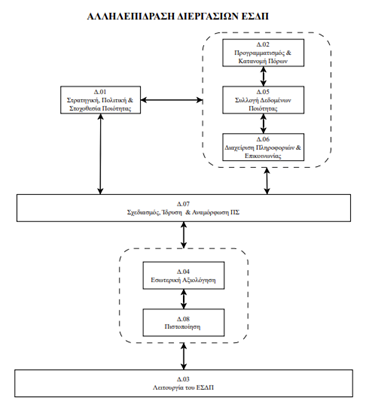
The EQAS includes requirements, which the Foundation fulfills, in order to obtain certification for the operation of its Internal Quality Assurance System. The Quality Handbook is an official document of the EDP and is used as a guide for its implementation. It consists of processes and aims to meet the requirements of the relevant quality standard of the EAEA. The processes take into account elements, called input data and are necessary for the operation of the process. The results of the process are called output data. Each process is evaluated internally, both in terms of its functionality itself and in terms of its effectiveness (i.e., if, if, it results in sufficient results to justify its existence). Indicators are used to evaluate effectiveness, which are described in the Handbook. The process is the way in which the process is implemented. The process has a beginning, an end and stages or steps. The procedures include stages or steps, which must be followed in order to achieve the intended result of the process. The documentation of the processes is achieved through the necessary documents and forms (in electronic or paper form) in order to make it possible to monitor and verify compliance with the prescribed procedures.
The IQAS include the following processes:
Process 1 – Strategy, Policy & Quality Target Setting
The Aristotle University of Thessaloniki prepares its Strategic Plan, defines the strategic objectives and monitors its implementation, carrying out any revision/update deemed necessary.
The Aristotle University of Thessaloniki implements a quality assurance policy, which is part of its strategic planning. This policy is developed and specialized in the Foundation's fields of action, is made public and implemented by all interested parties.
The Aristotle University of Thessaloniki establishes clear and defined objectives to ensure and continuously improve the quality of the curricula provided, research and innovation activities, as well as scientific and administrative services. These objectives can be quantitative and qualitative and derive from the Foundation's strategy.
Process 2 – Planning and Resource Allocation
The Aristotle University of Thessaloniki should have sufficient resources to meet its teaching, learning, research and academic and operational needs in general. It should have adequate funding, infrastructure, services and human resources for education and research, and facilitate direct access to them by establishing internal rules (e.g. classrooms, workshops, libraries, networks, student care, careers, social policy services, etc.)
Process 3 – Operation of the IQAS
The Aristotle University of Thessaloniki establishes and organizes the internal quality assurance system, which includes processes and procedures that correspond to all academic activities and functions. In particular, they focus on the quality of learning and teaching - including the learning environment - on research, innovation and management with a view to continuous improvement on the one hand and the implementation of legislation and certification standards on the other.
Process 4 – Internal Evaluation
The EDP includes procedures that provide for an annual internal evaluation of the Institution's academic, research and administrative functions. The Process aims to identify errors or gaps and to carry out corrective actions in order to achieve the objectives set, with the expected result of improving quality.
For the internal evaluation process, and for any procedures deemed appropriate, the HAHE quality standards (e.g. quality standards for curricula) are used. For cases in which there are no relevant standards from the HAEAE, MODIP may utilize data and reports from the existing quality systems of the units (indicatively, ISO Quality Standards, EFQM, etc.), in cooperation with them.
The Institution's decisions to correct, comply or improve its operation are taken in the context of the annual review of the NAPs.
Process 5 – Quality Data Collection: Measurement, Analysis and Improvement
The Aristotle University of Thessaloniki collects, analyzes and uses information in a uniform, functional and immediately accessible way, in order to effectively manage the quality data of educational, research and other academic activities, as well as the data of administrative functioning. Important data collected relate to the HAEAE Information System for the collection of quality data from HEIs and the data submitted for the Achievement Report. It is noted that data are also collected from stakeholder satisfaction measurements, with the main ones being the questionnaires for the evaluation of teaching work and teachers.
Process 6 – Information and Communication Management
The Aristotle University of Thessaloniki publicizes its educational, academic and research activities in a direct and accessible way. The information is published on the Foundation's website and in the official NCAs. The Aristotle University of Thessaloniki publishes the applied Quality Assurance System and the Quality Policy and informs all interested parties about it. Care is taken to ensure that the relevant information is up-to-date and formulated in a complete, objective and clear manner.
Process 7 – Design, Establishment and Reform of Study Programmes
The Aristotle University of Thessaloniki implements specific procedures for the design and establishment of new Study Programs, as well as for the control and reform of aspects of existing Study Programs (undergraduate, postgraduate or doctoral studies in Greek or foreign languages), in order for them to meet the current legislation and standards of the HAHA and to meet the objectives and learning outcomes that have been set.
Process 8 – Certification
The Aristotle University of Thessaloniki undergoes periodic external evaluation by committees of experts appointed by the HAEAE, in order to certify both the Internal Quality Assurance System, the Study Programs and the Lifelong Learning Center.